

A Civilisational Predicament in a Nutshell
Over the course of a few hundred years human society has grown exponentially in scale becoming irreversibly ever-more singular, complex, interdependent, high-speed, efficient, systemically stable and predictable. It expresses an emergent global civilisation, and its evolution in time, the Anthropocene Trajectory, figure:1. Through its integration and continuity, locally and globally, the conditions sustaining normal life are maintained. This includes access to food, water, sanitation, power, communications, transport, economic production, governance, cooperation, and expectations, and more broadly, the basic configuration, and functioning of human society. Global systemic risk arises from threats and processes that can undermine this trajectory’s integrity and persistence.
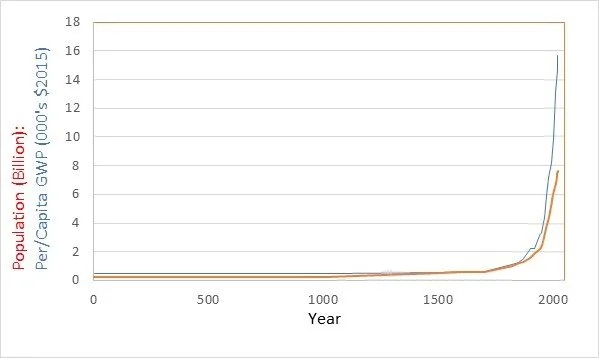
Figure: 1 The Anthropocene Trajectory. World population and per capita Gross World Product for the last 2000 years. Through history complex societies and empires have risen and fell, but their scale is dwarfed by the Anthropocene inflection beginning about 250 years ago. Spanning about 1/1000th and 1/40th of the history of anatomically modern humans, and the period since the beginning of agriculture respectively, it’s an extreme anomaly in our species history, and potentially epochal in Earths’. This hockey stick inflection correlates with an exponentially expanding and complexifying socio-economic metabolism; escalating inputs of energy and materials without which it would not have emerged and be sustained; and the myriad waste stream (e.g. greenhouse gasses, plastics,) and catastrophic destruction of non-human life that result from the transformation process. Data: Maddison Project Database, version 2020.
The overarching driver of escalating systemic risk is the emergent and interactive impacts of civilization’s maintenance, adaptation and growth processes upon its own operation and continuity. This is contributing to systemic risk through increasing vulnerability of the interdependent networks and systems that we have come to depend upon, and as the generator, directly and indirectly, of accelerating stresses and shocks that can interact to expose those same vulnerabilities. Global systemic risk is escalating due to the emergent implications for societal stability and continuity arising from the growing range and intensity of stressors and shocks and their dynamic interactions through increasingly vulnerable societal systems.
From this integrative, trajectory/vulnerability-focused perspective, society is severely underestimating the urgency, likelihood, scale, and duration of emerging risk. Whilst the Anthropocene trajectory has been resilient here-to-fore, new dynamics are becoming possible. Broad features including a growing likelihood of 1) persistent socio-economic stress, stagnation, and increasing systemic volatility and uncertainty; 2) severe localised systemic disruptions with some recovery; 3) the onset of a re-enforcing process of global systemic destabilisation, and 4) global systemic collapse. The inherent vulnerability of the trajectory means that systemic destabilisation can emerge rapidly, and by triggering networked socio-economic thresholds and tipping points, drive a fast, re-enforcing collapse of the trajectory. This outcome would be experienced as an irreversible shut-down in the global metabolism, and flows of goods and services.
The description above may be one way of framing the cluster of concepts around the perma-poly-meta crisis.[i],[ii],[iii] Their foregrounding of ‘crisis’ obscures that overwhelmingly crises are the symptomatic manifestations of a directed underlying process. That is, the conditions that enabled the Anthropocene trajectory’s integration and continuity is being increasingly undermined reflecting that we’re likely in the era of the Limits to Growth[iv],[v].
There is little reason to believe that this course of the Anthropocene trajectory can be purposefully altered in any meaningful way. We’re locked-into self-organizing processes of unimaginable complexity that we did not design, but rather co-evolve with. That which sustains us, what we cling to, what frames and constitutes the processes of habitual existence, including attempts to mitigate and adapt in response to a more dangerous world, is part of what is undermining the trajectory’s own persistence. It is systemic lock-in that explains why the most predictable feature of civilizations’ course to this moment has been the sustainability of accelerating unsustainability.
The emergent thermodynamic-evolutionary adaptations and constraints that have brought Homo Sapiens and its civilizational niche within the earth system into being situate the trajectory lock-in as natural, systemic, and inevitable.
Authors Note:
If this perspective on global systemic risk seems unfamiliar or too abstract and concentrated, however the publications part of this site contains 15 years of studies and essays on global systemic risk, systemic vulnerability, integrated risk and so on, all filled with examples and discussion. One essay therein, ‘Brexit, Systemic Risk, and a Warning for a Changing World’ is probably the best introduction (don’t worry about the Brexit reference, it’s just the framing for the introduction).
References
[i] Brown, G. El-Erian, M. Spence, M. Permacrisis: A plan to fix a fractured world. Simon & Schuster (2023).
[ii] Michael Lawrence, Scott Janzwood, Thomas Homer-Dixon. What is a polycrisis crisis? And how is it different from systemic risk? Technical Paper 2022-4. (Sept 16, 2022). Cascade Institute. www.cadeinstitute.org.
[iii] Rowson, J. How to think about the meta-crisis without getting too excited. Centre for the Understanding of Sustainable Prosperity (CUSP). (Feb 2020). https://cusp.ac.uk/themes/m/blog-jr-meta-crisis/
[iv] Meadows, Donella H; Meadows, Dennis L; Randers, Jørgen; Behrens III, William W (1972). The Limits to Growth; A Report for the Club of Rome's Project on the Predicament of Mankind. New York: Universe Books
[v] Nebel, Arjuna; Kling, Alexander; Willamowski, Ruben; Schell, Tim (November 2023). "Recalibration of limits to growth: An update of the World3 model". Journal of Industrial Ecology. doi:10.1111/jiec.13442.